
Pain Relief
Hip Pain: Causes, Symptoms and the Best Natural Treatment Options
2026-08-05
4 min read

2026-06-24 • 4 min read
There is a particular kind of stiffness that greets you first thing in the morning, before the day has even started. You reach down to tie your shoes and your lower back protests. You have sat at a desk for years and your spine feels like it has half forgotten how to move. If any of that sounds familiar, yoga for back pain and flexibility is one of the most practical, low-cost things you can start today, and the evidence behind it is stronger than most people expect.
At Reset, we care less about handing you a trendy fix and more about helping your body genuinely move better. So this is not a wall of Sanskrit or an intimidating hour-long flow. We will cover why yoga works for a sore, stiff back, the poses actually worth your time, a short routine you can do on the floor beside your bed, and the mistakes that quietly make things worse. Picture someone who long ago filed “touching my toes” under things other people do. A few weeks of gentle, consistent practice tends to rewrite that story. That is the whole promise here: move a little every day, and your back slowly starts to trust you again.
Yoga is not magic, and it helps to understand the mechanism before you commit to it. Three things do the heavy lifting. The first is strength. A back is only as supported as the muscles around it, and holding poses gently builds the core, the glutes, and the long muscles running either side of the spine. The second is mobility. Most stiff backs are stiff because the areas around them, the hips especially, have stopped moving well, so the lower back ends up doing work it was never designed for. Yoga gives that range back. The third is stress. Pain and tension feed each other, and the slow breathing built into a practice settles the nervous system, which takes a real edge off how much a back hurts.
The research supports it. The US National Center for Complementary and Integrative Health, part of the National Institutes of Health, reports that yoga can improve both pain and function in chronic low-back pain, with benefits broadly similar to other kinds of exercise (nccih.nih.gov). Clinical guidelines from the American College of Physicians go further and list yoga among the recommended non-drug options worth trying before reaching for medication. The honest caveat: the gains tend to be gradual and modest, and they arrive through consistency rather than intensity. This is a slow, reliable win, not an overnight one.
Table 1: What yoga builds, and how it helps your back
A quick word on safety first, because yoga helps most when you respect where your back actually is today. If your pain started with a specific injury, shoots down your leg, or comes with numbness or tingling, check with a doctor before starting anything new. Yoga suits ongoing, non-specific stiffness best, the everyday kind that is not tied to something more serious.
The golden rule is simple. Move to the edge of a stretch, never into sharp pain. A gentle, satisfying pull is fine and often exactly what you want. A sharp, pinching, or radiating sensation is your cue to ease off. Go slowly, keep breathing, and treat the first week as quiet exploration rather than a performance to nail.
You do not need a huge repertoire. A handful of well-chosen poses, done regularly, covers the essentials of spinal movement, hip opening, and gentle strengthening. Here are the ones worth learning first.
Table 2: Beginner-friendly poses for a sore, stiff back
If you only have time for two, make them Cat-Cow and Child's Pose. Cat-Cow wakes the whole spine and is the gentlest way to find out how your back is feeling on any given day. Child's Pose is the one to return to whenever you need a breather, since it lengthens the lower back and hips while you simply breathe. Everything else builds outward from those two.
Poses are ingredients. A routine is the meal. The sequence below moves from gentle warm-up to a little strengthening and finishes with something restful, which is roughly how a good practice should flow. Keep your breathing slow and steady throughout, inhaling and exhaling through the nose, and let the breath set the pace rather than rushing to the next shape.
Table 3: A 15-minute daily back-and-flexibility routine
Timing is less important than showing up. Morning practice loosens the overnight stiffness and sets up your posture for the day. Evening practice unwinds the tension you have collected and helps you sleep. Pick whichever you will actually repeat. Fifteen honest minutes most days beats a heroic hour you do once and abandon.
Yoga is safe for most backs, but a few habits turn a helpful practice into an aggravating one. Most of them come down to ego or impatience, and all of them are easy to fix once you know to watch for them.
Table 4: What trips people up, and what to do instead
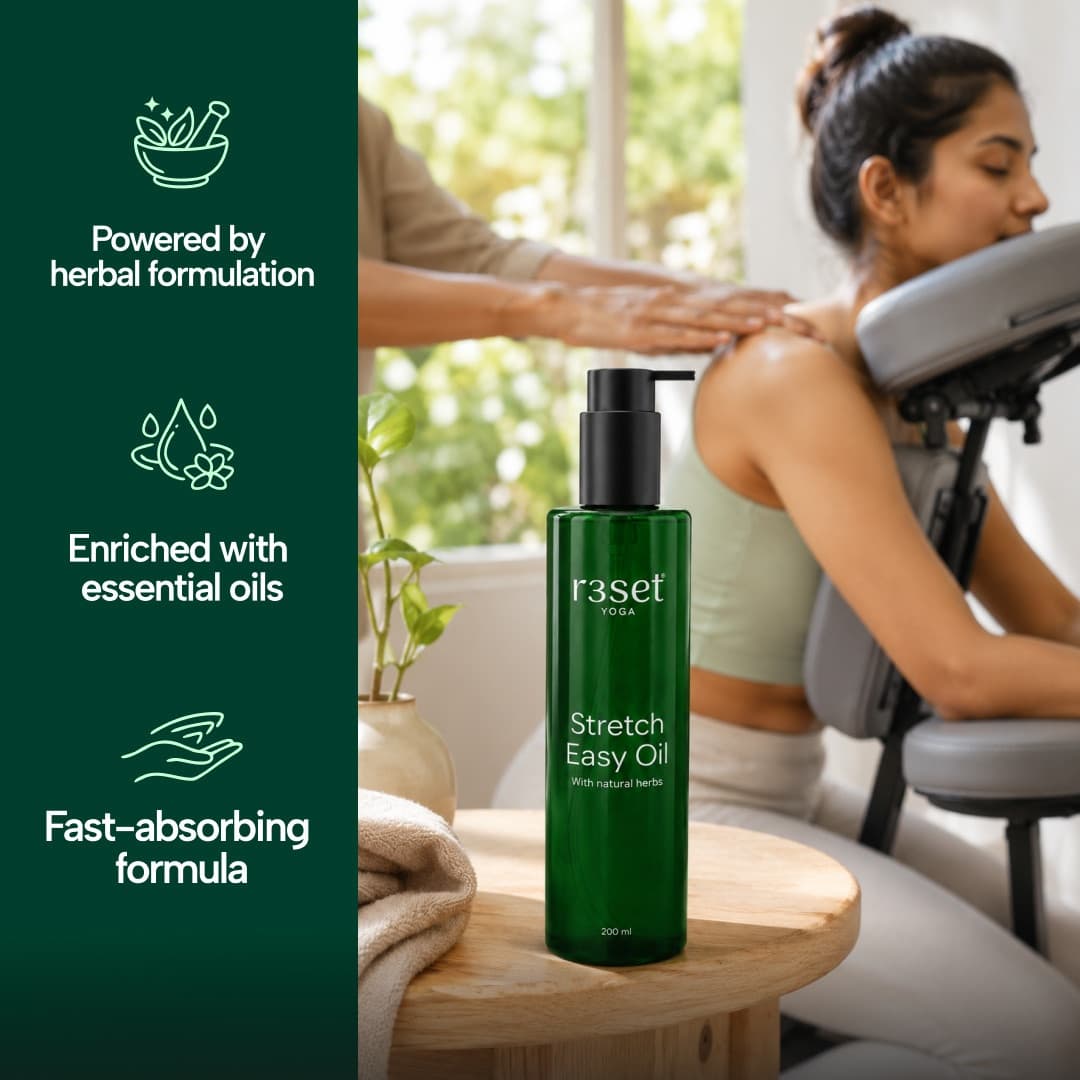
A practice sticks when it feels good, and a little ritual around it goes a long way. This is where Reset Stretch Easy Oil earns its place. It is an Ayurvedic massage and yoga oil built on a blend of essential oils, chamomile, geranium, lemongrass, rosemary, eucalyptus, and camphor, made to ease muscle tension, soothe everyday back and body stiffness, and support recovery after you move. It absorbs cleanly without leaving a greasy film, which matters if you are using it before rolling out the mat.
Use it two ways. Warm a little into tight hips, hamstrings, or the lower back before practice to loosen up, or massage it in afterwards as a slow wind-down, the way an Abhyanga self-massage is meant to feel. Readers often find the after-practice version becomes the part they look forward to. You can see the rest of Reset's yoga and recovery range if you want to build out the ritual further. None of this replaces medical care for a serious back problem, but for the everyday stiffness most of us carry, it makes the habit easier to keep.
•Yoga helps back pain by building strength, restoring mobility in the hips and spine, and calming the stress that makes pain feel worse.
•The evidence is solid: NIH's NCCIH and the American College of Physicians both support yoga for chronic, non-specific low-back pain, though gains are gradual.
•A short daily routine beats the occasional long session. Fifteen consistent minutes is plenty to start.
•Move to the edge of a stretch, never into sharp pain, and check with a doctor first if your pain radiates or followed an injury.
•A simple oil-based ritual before or after practice makes the habit easier to keep and eases post-practice stiffness.
For many people, yes, especially for ongoing, non-specific low-back pain. Health authorities including NIH's NCCIH note that yoga can improve pain and function, with results comparable to other forms of exercise. The key is doing it gently and regularly rather than expecting an instant fix.
Cat-Cow, Child's Pose, Sphinx or Cobra, a gentle supine spinal twist, and Bridge are reliable starting points. They cover spinal movement, lower-back release, and light strengthening. Legs-Up-the-Wall is a lovely, low-effort way to finish.
Most days, in short sessions, works better than one long weekly class. Even fifteen minutes daily gives your back the consistent, gentle movement it responds to. Consistency is what drives the improvement.
It can if you push into sharp pain, bounce through stretches, or attempt advanced poses too soon. Stick to gentle, back-friendly poses, stop at the edge rather than forcing depth, and see a doctor first if your pain radiates down a leg or came from an injury.
That is exactly who benefits most. Flexibility is built, not required upfront, and every pose can be modified with bent knees, blocks, or a shorter range. Start where your body is today, and the range grows over the weeks.
Both work, so pick what you will repeat. Morning practice eases overnight stiffness and improves your posture for the day, while evening practice releases the day's tension and can help you sleep.
Many people feel a little looser after a single session, but meaningful, lasting change usually takes a few weeks of regular practice. Think in terms of steady progress rather than a sudden transformation.
Either works. Before practice, a warming oil like Reset Stretch Easy Oil helps loosen tight areas so you move more freely. After practice, massaging it in supports recovery and eases stiffness, and it doubles nicely as a calming wind-down.
NIH National Center for Complementary and Integrative Health (Yoga for Pain); American College of Physicians low back pain guideline; Harvard Health.
Share this article:
Infused with 6 powerful essential oils

₹1,299.00
₹999.00
Enhance the quality of sleep and focus with a flavourful dose

₹489.00
An easy to apply potent formula with roll-on massager

₹549.00
₹449.00
| What yoga builds | How it helps your back |
|---|---|
| Core and back strength | Gives the spine steady support so it carries load with less strain |
| Hip and spinal mobility | Frees up nearby joints so the lower back stops overworking |
| Better body awareness | Helps you catch tension and poor posture before they build |
| Calmer nervous system | Lowers the stress and muscle guarding that amplify pain |
| Pose | What it targets | Quick how-to |
|---|---|---|
| Cat-Cow | Whole spine, warm-up | On all fours, alternate arching and rounding the back with your breath |
| Child's Pose | Lower back, hips | Kneel, sit toward your heels, walk your hands forward and rest your forehead down |
| Sphinx or Cobra | Lower back extension | Lie on your front, prop on forearms (sphinx) or hands (cobra), lift the chest gently |
| Downward Dog | Hamstrings, back, shoulders | From all fours, lift the hips up and back into an inverted V |
| Supine Spinal Twist | Spine, lower back release | On your back, drop bent knees to one side, look the other way, then switch |
| Bridge | Glutes, core, back support | On your back, feet flat, lift the hips in a slow, controlled line |
| Legs-Up-the-Wall | Relaxation, gentle decompression | Lie down with your legs resting up a wall, breathe slowly |
| Order | Pose | How long |
|---|---|---|
| Settle | Child's Pose | 1 minute of slow breathing |
| Warm up | Cat-Cow | 8 to 10 slow rounds |
| Extend | Sphinx or Cobra | 2 holds of about 20 to 30 seconds |
| Lengthen | Downward Dog | 2 holds of about 30 seconds |
| Release | Supine Spinal Twist | 30 to 45 seconds each side |
| Strengthen | Bridge | 5 slow lifts |
| Finish | Legs-Up-the-Wall | 2 to 3 minutes |
| Common mistake | Do this instead |
|---|---|
| Bouncing to go deeper into a stretch | Ease in slowly and hold, letting the muscle release on its own |
| Pushing through sharp pain | Stop at the edge; sharp pain is a signal, not a challenge |
| Holding your breath during hard poses | Keep breathing slowly; the breath is what calms the back |
| Skipping the warm-up | Always start with Cat-Cow or Child's Pose before deeper work |
| Chasing depth and comparing yourself to others | Work with your own range today; flexibility comes with time |

