
Muscle Soreness After Workout: Why It Happens & How to Recover Faster
2026-03-25 • 5 min read
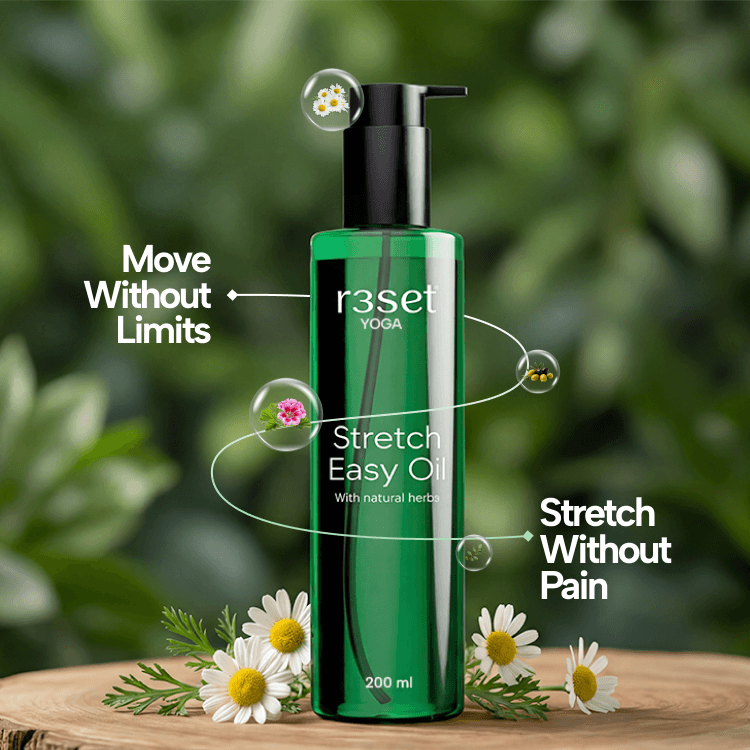
Soreness after exercise — known as Delayed Onset Muscle Soreness (DOMS) — is caused by micro-tears in muscle fibres that trigger localised inflammation via the COX/LOX enzyme cascade and NF-κB activation. Ayurvedic recovery oils containing Ashwagandha, Boswellia, and Nirgundi suppress these inflammatory pathways at the source, accelerating repair without the side effects of NSAIDs. For targeted post-workout recovery,
Reset's Stretch Easy Oil is formulated precisely for this biological repair window.
Why Do Muscles Feel Sore After a Workout?
Soreness after exercise is not a sign that something went wrong — it is a sign that your muscles were challenged beyond their current capacity. When you push muscles through unfamiliar or high-intensity movements, the mechanical stress causes microscopic tears in the muscle fibres, particularly in the Z-disc regions of the sarcomeres. This structural disruption signals your immune system to mount a localised repair response, and the resulting inflammation is what you feel as soreness after a workout.
The discomfort typically peaks between twenty-four and seventy-two hours after exercise — which is why you often feel fine immediately after training but wake up stiff the next morning. This delayed pattern is the defining feature of DOMS.
What Is DOMS and How Is It Different from Injury?
Delayed Onset Muscle Soreness (DOMS) is a normal physiological response to mechanical overload. It is diffuse, bilateral (both legs sore after leg day), and resolves on its own within three to five days. Acute injury pain, by contrast, is sharp, localised to one spot, may involve swelling or bruising, and does not follow the delayed 24–72 hour pattern.
What Biological Pathways Drive Post-Exercise Soreness?
The Inflammation Cascade Behind Muscle Soreness
Micro-tear-induced cytokine release: Damaged muscle cells release damage-associated molecular patterns (DAMPs), activating resident macrophages that secrete pro-inflammatory cytokines — TNF-α, IL-1β, and IL-6.
COX/LOX Enzyme Activation: Cytokine signalling upregulates cyclooxygenase (COX-1/2) and lipoxygenase (LOX) enzymes, converting arachidonic acid into prostaglandins and leukotrienes — the primary mediators of pain and swelling in sore muscles.
NF-κB Pathway Activation: Nuclear factor kappa-B acts as the master regulator of inflammatory gene expression. Sustained NF-κB activity during the repair phase prolongs the soreness window beyond the initial forty-eight hours.
TRPV1 Receptor Sensitisation: Prostaglandins sensitise transient receptor potential vanilloid 1 (TRPV1) nociceptors in muscle tissue, lowering their activation threshold and producing the characteristic tenderness to touch seen with DOMS.
Satellite Cell Recruitment: In parallel with inflammation, muscle satellite cells proliferate and differentiate to repair the micro-tears — this is the regenerative side of the same process. Recovery speed depends on how quickly the inflammatory phase resolves.
What Botanicals Speed Up Muscle Recovery?
How Does Ayurvedic Recovery Compare to Allopathic Treatment?
How Can I Recover Faster from Muscle Soreness?
Step-by-Step Post-Workout Oil Application Protocol
Cool down first: Never apply oil to skin that is heavily flushed from exercise. Wait ten to fifteen minutes post-workout to allow core temperature to stabilise.
Warm the oil: Rub a few drops of Reset Stretch Easy Oil between your palms for fifteen seconds, or place the bottle in warm water for two minutes. Warm oil penetrates significantly deeper than cold.
Apply to the affected muscle group: Start with light effleurage strokes — long, sweeping movements directed toward the heart — to prime lymphatic drainage and reduce swelling.
Deep circular massage: Work in firm circular motions along the muscle belly with your fingertips or thumbs. For larger groups (quads, hamstrings), use the heel of the palm.
Treat the attachments: Apply additional pressure at muscle-tendon junctions where DOMS is most intense — for example, the bottom of the quad just above the knee, or the upper hamstring below the glutes.
Allow twenty-plus minutes of absorption: Leave the oil on without washing. Overnight application after an evening session is ideal — the recovery window runs through sleep.
Follow with gentle mobility: Post-application, perform two to three minutes of slow, controlled movement through the sore range. This combines the oil's anti-inflammatory action with active fascial release.
Apply Reset Stretch Easy Oil immediately after this protocol — its herbal actives are formulated to engage the post-exercise inflammatory window directly.
How Often Should I Apply Recovery Oil After a Workout?
Which Remedy Works Best for My Type of Soreness?
How do I choose the right product? Match your symptom pattern to the active that targets it most precisely.
What Are the Best Remedies for Post-Workout Pain?
Recovery science points to a tiered approach — no single remedy does everything, but the right combination covers all five inflammatory pathways simultaneously.
Of these, topical application of Reset Stretch Easy Oil is the fastest-acting intervention for localised soreness — effects are felt within fifteen to twenty minutes of application.
When Should Soreness Be a Concern?
Most soreness after exercise is benign and self-resolving. However, certain warning signs demand prompt medical attention rather than home management.
Seek medical assessment if soreness is accompanied by dark brown or cola-coloured urine — this can indicate rhabdomyolysis, a serious condition where muscle protein floods the bloodstream and overwhelms the kidneys. Also get assessed if you experience sharp, localised pain at a joint or bone rather than a diffuse ache across a muscle belly, if swelling is asymmetrical and significant, if pain is progressively worsening beyond seventy-two hours rather than improving, or if you have lost meaningful range of motion or strength that does not return within a week.
For normal DOMS — bilateral aching, stiffness, and tenderness that peaks at 48 hours and resolves within five days — herbal topical oils, active recovery, and adequate sleep are the appropriate and sufficient response.
Why Choose Reset Stretch Easy Oil for Recovery?
Reset's Stretch Easy Oil is a medicated herbal recovery oil built on classical Ayurvedic formulation principles and designed specifically for post-exercise tissue repair. Its base of sesame and castor oil carries Ashwagandha, Boswellia, Nirgundi, and Mahanarayan actives deep into muscle and fascial layers — addressing the COX, LOX, NF-κB, and TRPV1 pathways that drive soreness after workout simultaneously.
It contains no parabens, mineral oil, or artificial fragrance. The formula absorbs within twenty minutes without leaving a greasy residue, making it practical to apply post-training at the gym, at home, or before sleep. For athletes, daily users, and desk workers dealing with exercise-related soreness alike, it serves as a non-pharmaceutical, side-effect-free recovery foundation.
Frequently Asked Questions
Why do muscles feel sore after a workout?
Soreness after exercise is caused by microscopic tears in muscle fibres during high-intensity or unfamiliar training. These tears trigger an inflammatory repair cascade — involving COX/LOX enzymes, NF-κB activation, and prostaglandin production — that peaks at twenty-four to seventy-two hours post-exercise. This is DOMS, and it is a normal, necessary part of the adaptation process.
How can I recover faster from muscle soreness?
The fastest evidence-based recovery stack combines warm herbal oil massage immediately post-workout, cold-to-warm contrast therapy in the first twenty-four hours, active recovery (light walking or yoga) on days two and three, seven to nine hours of sleep, and adequate protein intake. Reset Stretch Easy Oil used as part of this protocol addresses the inflammatory biology directly at the site of soreness.
What are the best remedies for post-workout pain?
Herbal topical oils (COX/LOX and TRPV1 action), active recovery for lactate clearance, contrast therapy for swelling, anti-inflammatory nutrition, and quality sleep are the five most effective remedies supported by recovery science. Oral NSAIDs, while commonly used, may actually impair satellite cell activity and slow the muscle repair process when taken consistently.
When should soreness be a concern?
Soreness becomes a concern when it is sharp and localised to a specific joint or bone, worsens beyond seventy-two hours, is accompanied by significant asymmetrical swelling, or produces dark-coloured urine — which may indicate rhabdomyolysis. Normal DOMS is diffuse, bilateral, peaks at forty-eight hours, and resolves within five days.
Is it okay to exercise through muscle soreness?
Light to moderate activity on sore muscles is beneficial — it improves blood flow and lactate clearance. Heavy training on maximally sore muscles, however, increases injury risk because neuromuscular coordination is compromised when tissue is acutely inflamed. A day of active recovery (walking, swimming, yoga) is more productive than forcing another hard session.
Does heat or cold work better for post-workout soreness?
Both have a role, depending on timing. Cold (ice or cold water immersion) works best in the first twenty-four hours to limit swelling and acute inflammation. Heat — including from warm herbal oils — works better from twenty-four hours onward, when it improves blood flow, accelerates metabolite clearance, and activates TRPV1-mediated analgesia.
Can massage oil actually reduce DOMS?
Yes — research supports topical herbal application as a meaningful DOMS intervention. Massage itself improves local circulation by up to 30% and disrupts fascial adhesions. Herbal actives like Boswellia and camphor add pharmacological anti-inflammatory and analgesic action on top of the mechanical benefit, shortening the soreness window measurably.
How long does soreness after a workout typically last?
Standard DOMS resolves in three to five days without any intervention. With active recovery, quality sleep, and herbal oil massage applied two to three times daily, most people experience meaningful relief within twenty-four to forty-eight hours and full resolution within three days.
Is soreness a sign that the workout was effective?
Soreness is a sign that you challenged your muscles beyond their current capacity — not necessarily a sign of an effective workout. Well-conditioned athletes often train very hard with minimal DOMS because their tissue has adapted. Chasing soreness as a metric is not a reliable training strategy; progressive overload tracked through performance metrics is more meaningful.
Can herbal oils help prevent soreness before it starts?
Pre-workout application of a warm herbal oil can prime circulation, improve fascial mobility, and reduce the initial inflammatory burden — potentially blunting the severity of DOMS. Apply ten to fifteen minutes before training to allow the botanical actives to penetrate and activate thermoreceptors before mechanical stress begins.
Are there Ayurvedic dietary tips to complement oil therapy for soreness?
Yes. Turmeric with black pepper (curcumin + piperine) consumed post-workout provides systemic NF-κB suppression that complements topical oil application. Ashwagandha root supplement reduces cortisol and exercise-induced oxidative stress over time. Adequate protein (1.6–2.2g per kg bodyweight daily) provides the amino acid substrate for satellite cell-mediated muscle repair.
Does the type of exercise affect how sore I get?
Eccentric-dominant exercises — downhill running, lowering heavy weights slowly, landing from jumps — produce the most severe DOMS because they generate more mechanical tension during muscle lengthening under load. If you are introducing these movements or returning after a break, progressive loading reduces the severity of post-exercise soreness significantly.
Key Takeaways
Soreness after exercise is biology, not failure — micro-tears and the resulting inflammation are how your muscles grow stronger; the goal is to accelerate the repair phase, not eliminate it.
Apply warm herbal oil within thirty minutes of training — this is the optimal window to intercept the COX/LOX cascade before prostaglandin levels peak.
Avoid chronic NSAID use for DOMS — research shows regular ibuprofen use can impair satellite cell activity and slow the very muscle repair you're trying to accelerate.
Sleep is non-negotiable — the majority of muscle repair occurs during slow-wave sleep through growth hormone secretion; no supplement or oil compensates for sleep deprivation.
Know the red flags — dark urine, asymmetric swelling, or worsening pain beyond seventy-two hours requires medical review, not more self-treatment.
Move gently on sore days — light movement clears lactate and improves circulation more effectively than complete rest.
Make Reset Stretch Easy Oil your post-session ritual — consistent application across training cycles reduces baseline soreness severity over time through cumulative anti-inflammatory effect.
Related Reading
• Reset Stretch Easy Oil — Product Page
• Massage Oils: Benefits, Types & How to Use Them Effectively
Share this article: